
 By
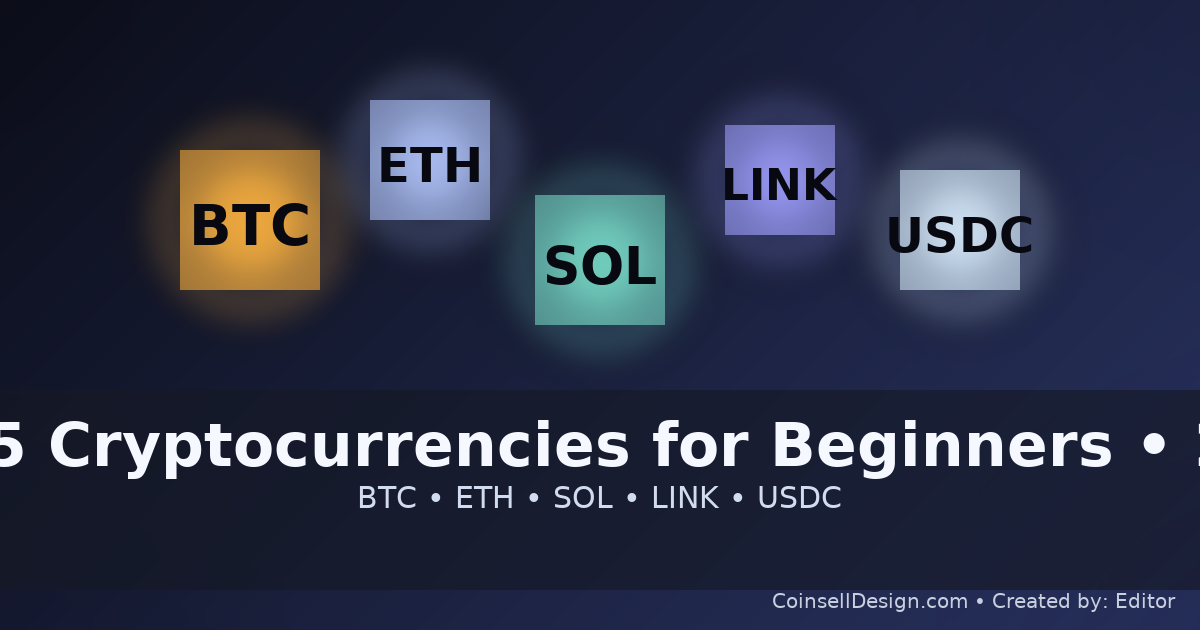
By 🌟 Top 5 Cryptocurrencies for Beginners to Buy in 2025 (With Low Fees)
New to crypto? This beginner-friendly list focuses on large, widely-used coins with real utility, deep liquidity, and strong ecosystems. You’ll also learn the risks and how to buy safely.
Created by: Editor • Updated: October 24, 2025 • 10–12 min read
Claim Your Coinbase Bonus
How we chose these coins
- Market leadership: Large market caps and deep liquidity.
- Real utility & adoption: Payments, smart contracts, DeFi, oracle data, or base money use-cases.
- Beginner-friendly: Easy to find on major exchanges (like Coinbase) with clear documentation.
- Risk-aware: We still list key risks for each coin so you can avoid surprises.
Note: This is educational content, not investment advice. Crypto is volatile.
The Top 5 Cryptocurrencies for Beginners in 2025
1) Bitcoin (BTC)
What it is: The original cryptocurrency and most widely held digital asset. Often seen as “digital gold.”
Why beginners like it: Highest liquidity, simple thesis (21M cap), widely available on every major exchange.
- Use-case: Long-term store of value; hedge against monetary inflation.
- Beginner tip: Consider dollar-cost averaging (DCA) small amounts over time.
- Key risks: High volatility; macro-sensitive; narratives can change quickly.
2) Ethereum (ETH)
What it is: A smart-contract platform powering DeFi, NFTs, and tokenized assets.
Why beginners like it: Massive developer ecosystem and many real apps; staking is widely available.
- Use-case: Pay for transactions on Ethereum; collateral and gas across the ecosystem.
- Beginner tip: Learn the difference between L1 (Ethereum) and L2 networks for lower fees.
- Key risks: Network congestion can spike fees; smart-contract risks in third-party apps.
3) Solana (SOL)
What it is: High-throughput blockchain focused on speed and low fees, popular for consumer apps.
Why beginners like it: Fast confirmations and low transaction costs make experimenting cheaper.
- Use-case: DeFi, payments, on-chain apps with near-instant UX.
- Beginner tip: Try small transactions first; keep seed phrases offline.
- Key risks: Throughput trade-offs; ecosystem smart-contract risks.
4) Chainlink (LINK)
What it is: The leading oracle network that feeds real-world data to blockchains and enables cross-chain messaging (CCIP).
Why beginners like it: It’s infrastructure used by many projects you’ll touch in DeFi and tokenized assets.
- Use-case: Price feeds, proof-of-reserve, and cross-chain interoperability.
- Beginner tip: Great way to learn how data flows into DeFi.
- Key risks: Infrastructure adoption cycles; token price can still be very volatile.
5) USD Coin (USDC)
What it is: A regulated U.S. dollar stablecoin issued by Circle, designed to hold a steady value of ~$1.
Why beginners like it: Useful as a stable “cash” position while learning or waiting to buy dips.
- Use-case: Parking funds, moving money between exchanges or chains, earning modest yields in select products.
- Beginner tip: Treat USDC as a tool for stability, not a growth investment.
- Key risks: Counterparty/regulatory risk at the issuer or banking partners; peg stress in extreme events.
Quick comparison table
| Asset | Core Role | Why Beginner-Friendly | Primary Risks |
|---|---|---|---|
| BTC | Store of value | Most liquid; simple thesis | Volatility; macro sensitivity |
| ETH | Smart contracts & DeFi base | Huge ecosystem; staking | Gas spikes; contract risk |
| SOL | High-speed apps & payments | Low fees; fast UX | Ecosystem risk |
| LINK | Data oracles & cross-chain | Used by many DeFi apps | Adoption cycles; volatility |
| USDC | Stable “cash” position | Holds ~$1; easy transfers | Issuer/regulatory risk |
How to buy with low fees (quick start)
- Open a trusted exchange account: see our Coinbase setup guide.
- Deposit a small amount you can afford to lose.
- Use limit orders where possible and avoid peak network congestion.
- Store long-term holdings in a secure wallet (consider hardware wallets for larger amounts).
- Optionally set up DCA (recurring buys) to smooth volatility.
Get Started on Coinbase
Frequently asked questions
Is this financial advice?
No. This article is educational. Always do your own research and consider speaking with a licensed professional.
Should beginners hold just one coin?
Diversifying across a few leaders (e.g., BTC + ETH + one platform like SOL) can reduce single-asset risk while you learn.
How do I keep my crypto safe?
Enable 2FA, use a hardware wallet for larger balances, and never share your seed phrase. Bookmark official sites to avoid phishing.
Risk disclaimer
Cryptocurrencies are volatile and can lose value rapidly. Never invest money you need for essential expenses. Past performance is not indicative of future results.