
 By
By 🏦 Centralized vs Decentralized Exchanges: What’s the Difference? (Beginner’s Guide)
Learn the key differences between centralized (CEX) and decentralized (DEX) cryptocurrency exchanges — and find out which one is better for your trading style, security, and goals.
🔹 What Is a Centralized Exchange (CEX)?
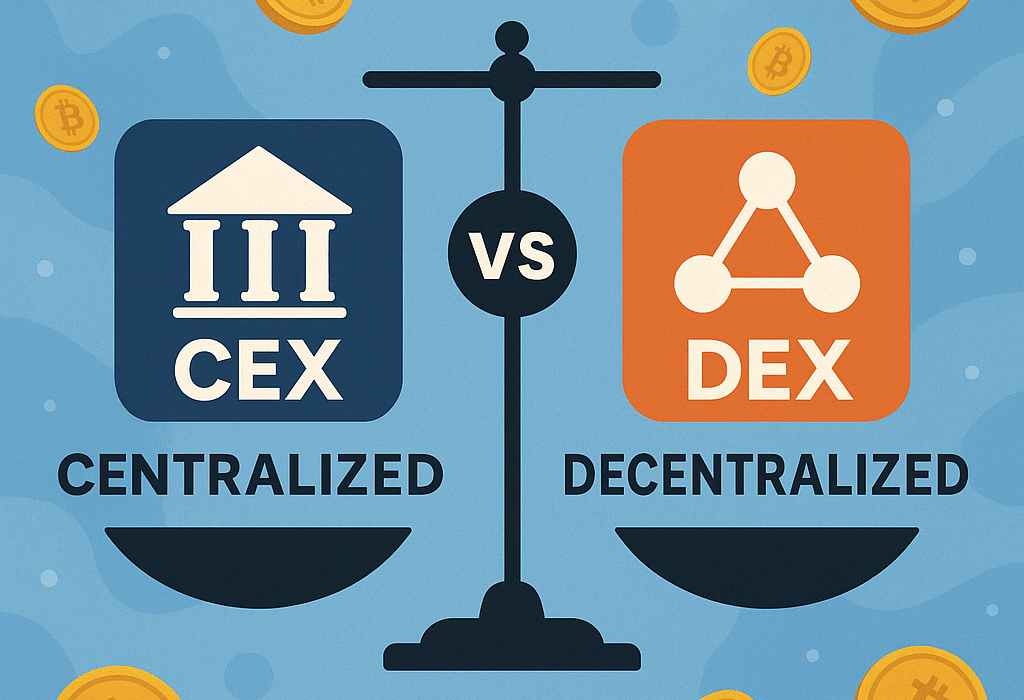
A centralized exchange (CEX) is a crypto trading platform operated by a company or organization that acts as a middleman between buyers and sellers. Examples include Coinbase, Binance, and Kraken.
These platforms manage your account, hold your funds, and process your trades through their system. You typically need to create an account, verify your identity (KYC), and deposit funds before trading.
✅ Pros of Centralized Exchanges
- Beginner-friendly with simple interfaces
- High liquidity and faster trade execution
- Customer support and recovery options
⚠️ Cons of Centralized Exchanges
- Custodial — exchange controls your funds
- Potential security risks (hacks, breaches)
- Requires personal verification (KYC)
🔸 What Is a Decentralized Exchange (DEX)?
A decentralized exchange (DEX) is a blockchain-based trading platform that lets users trade directly from their own wallets — without a central authority or intermediary. Examples include Uniswap, PancakeSwap, and dYdX.
DEXs use smart contracts to match and execute trades automatically. You connect your crypto wallet (like MetaMask) and trade peer-to-peer, keeping full control of your private keys and assets.
✅ Pros of Decentralized Exchanges
- Non-custodial — you keep control of your funds
- No KYC required — privacy friendly
- Global and censorship-resistant
⚠️ Cons of Decentralized Exchanges
- Lower liquidity compared to CEXs
- Higher risk of user error (no recovery if funds lost)
- Limited support and fewer trading pairs
⚖️ CEX vs DEX: Side-by-Side Comparison
| Feature | Centralized Exchange (CEX) | Decentralized Exchange (DEX) |
|---|---|---|
| Control of Funds | Exchange holds custody | User holds custody |
| KYC Required | Yes | No |
| Liquidity | High | Medium to low |
| Ease of Use | Very beginner-friendly | Moderate — requires some knowledge |
| Security | Exchange risk | User responsibility |
🧭 Which One Should You Use?
If you’re a beginner or just starting to buy and sell crypto, a centralized exchange like Coinbase is often easier to use and offers customer support if something goes wrong.
If you value privacy, control, and decentralization, a DEX may be more appealing — especially once you’re comfortable managing your own wallet and private keys.
💡 Tip: Combine Both!
Many traders use both types: a CEX for fiat on-ramps (buying crypto with USD) and a DEX for DeFi trading or swapping tokens without giving up custody.
🚀 Start Your Crypto Journey
Ready to start trading safely? You can open a free Coinbase account below and earn a crypto bonus: