
 By
By Trump Praises Crypto as Relief for Dollar – What It Means for Bitcoin
By Editor | November 6, 2025

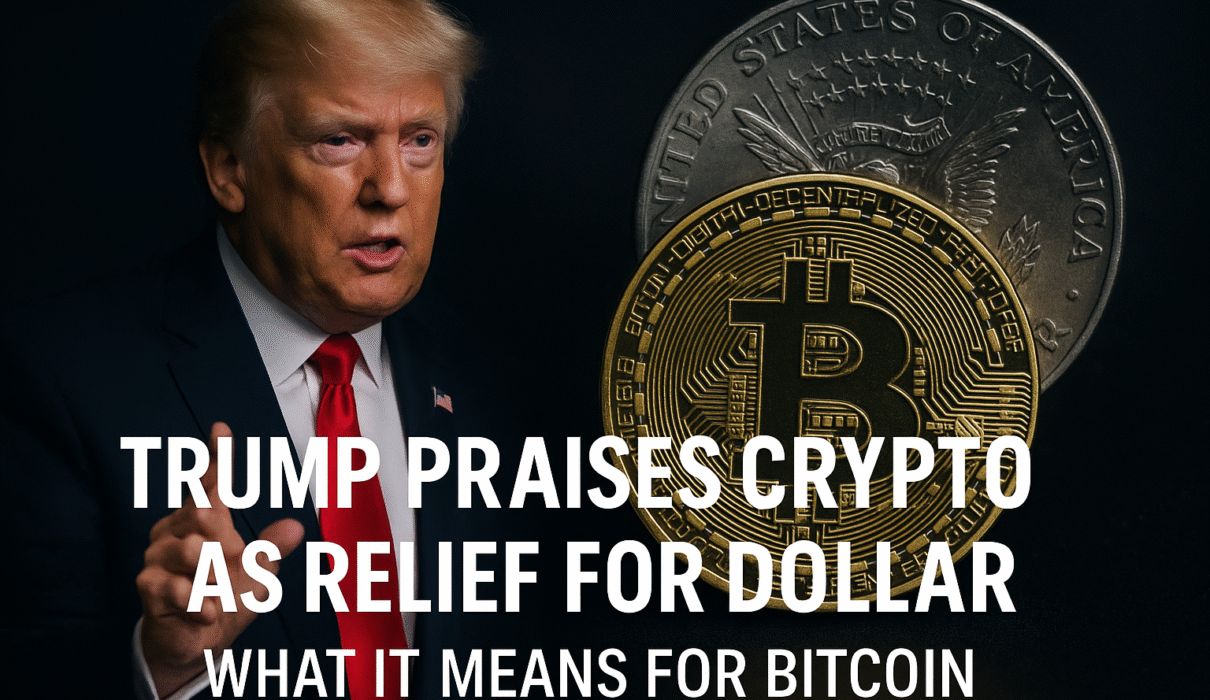
At the America Business Forum in Miami on November 5, 2025, Donald Trump declared that cryptocurrencies “take a lot of pressure off the dollar,” positioning the U.S. to become the “bitcoin superpower” and “crypto capital of the world.” :contentReference[oaicite:2]{index=2}
What Trump is saying
According to the report, Trump said his executive orders ended what he described as the federal government’s “war on crypto.” He contrasted his approach with the regulatory-heavy stance of the current administration, suggesting that his policies will boost America’s leadership in crypto and artificial intelligence. :contentReference[oaicite:3]{index=3} He further suggested that increased crypto adoption could ease strain on the U.S. dollar and help the U.S. consolidate its global financial position. :contentReference[oaicite:4]{index=4}
The Dollar-Bitcoin Paradox
Here’s where things get interesting: despite bullish rhetoric around crypto easing pressure on the dollar, empirical data show that when the U.S. dollar strengthens, the price of Bitcoin tends to fall—and vice-versa. :contentReference[oaicite:6]{index=6} In other words, if crypto adoption strengthens the dollar, it may *paradoxically* hurt Bitcoin’s performance.
The article notes that Bitcoin has exhibited an inverse correlation of approximately –0.7 with the U.S. Dollar Index (DXY) during certain periods. :contentReference[oaicite:7]{index=7} During the 2022 tightening cycle by the Federal Reserve, for example, the dollar surged to ~114 while Bitcoin plunged from ~$47,000 to under ~$17,000. :contentReference[oaicite:9]{index=9} Conversely, the 2020-2021 period of dollar weakness coincided with Bitcoin climbing to record highs near ~$64,000. :contentReference[oaicite:10]{index=10}
Why the tension exists
- Bitcoin behaves more like a high-beta risk asset than a traditional safe-haven store of value. It tends to rise during loose monetary conditions and fall when liquidity is being withdrawn. :contentReference[oaicite:11]{index=11}
- If crypto adoption truly relieves pressure on the dollar by providing an alternative transaction or store-of-value mechanism, that might lead to a stronger dollar overall. A stronger dollar historically has been linked to weaker Bitcoin. Thus, the policy goal (strengthening the dollar via crypto) could be at odds with Bitcoin’s price dynamics. :contentReference[oaicite:12]{index=12}
Strategic reserve and stablecoin push
The article also mentions U.S. lawmakers and government officials exploring large-scale crypto initiatives. Cynthia Lummis recently advocated for a “Strategic Bitcoin Reserve” as a way to offset the U.S.’s multi-trillion-dollar debt. :contentReference[oaicite:14]{index=14} The plan allegedly starts with over 130,000 BTC obtained through criminal forfeitures, valued around $34 billion, requiring no new taxpayer spending. :contentReference[oaicite:15]{index=15}
Meanwhile, stablecoins are also in focus. The notion is that tokenised dollars could channel global capital into U.S. markets—further strengthening the dollar. But such flows may reduce the relative appeal of Bitcoin as a non-dollar alternative. :contentReference[oaicite:16]{index=16}
What this means for crypto investors
If you’re investing in crypto, here are some considerations based on this development:
- Macro context matters. Broad dollar strength, interest-rate expectations, and liquidity conditions could override bullish sentiment from political commentary.
- Bitcoin isn’t insulated. Even if crypto adoption is seen as positive, it doesn’t guarantee Bitcoin will benefit—especially if broader macro conditions favour dollar strength.
- Different crypto sectors may behave differently. Stablecoins, tokenised dollars, and crypto assets tied to U.S. infrastructure may gain from a dollar-strengthening scenario more than Bitcoin itself.
- Monitor correlation changes. The historical inverse relationship between Bitcoin and the dollar may shift if new frameworks (sovereign reserves, regulatory regimes) alter how these assets interact in macroeconomics.
Wrap-up
In summary: while the rhetoric from President Trump and his team paints a picture of crypto alleviating dollar stress and boosting U.S. financial leadership, the underlying market dynamics tell a more nuanced story. Bitcoin’s price has historically moved opposite to the U.S. dollar, meaning that strengthening the dollar could inadvertently weigh on Bitcoin’s appeal. Investors should keep this paradox in mind when navigating the evolving crypto-macro landscape.
For more insights into how macro-dynamics impact crypto markets, check our detailed piece on What Drives Bitcoin Price? Macro Factors Explained and our step-by-step guide to How to Open a Coinbase Account and Start Trading Cryptocurrency (Beginner’s Guide).