
 By
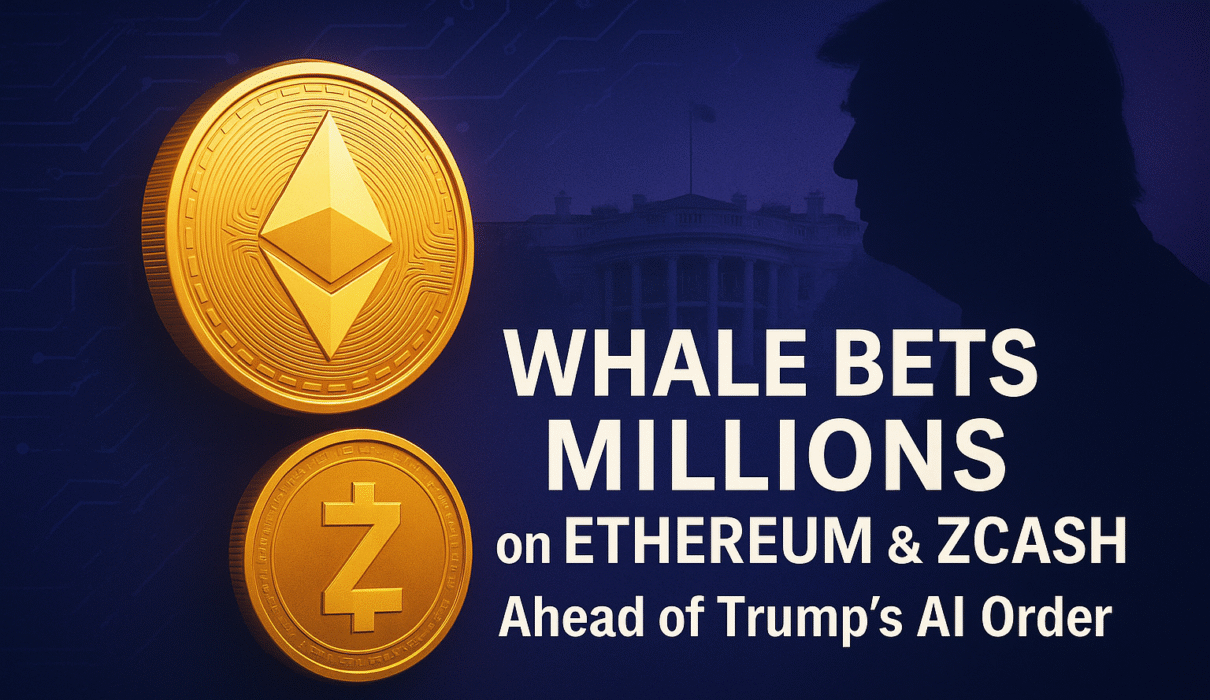
By Whale Bets Millions on Ethereum and Zcash Ahead of Trump’s AI Executive Order

A mysterious crypto whale has placed a massive leveraged bet on Ethereum (ETH) and Zcash (ZEC) just before former President Donald Trump’s 4PM executive order on artificial intelligence (AI) and state-level regulation. The timing, size and structure of the trade have caught the attention of traders across the market — and raised a big question: is this just another speculative gamble, or a signal about how well-placed insiders expect crypto to be in an AI-driven future?
As always, this article is for education only and is not financial advice.
What Actually Happened? The Hyperliquid Mega-Bet
According to public derivatives data from the decentralized exchange Hyperliquid, a single account opened multi-million-dollar long positions on ETH and ZEC ahead of Trump’s AI executive order. The trader used leveraged perpetual futures, taking roughly 5x leverage on Ethereum and around 10x leverage on Zcash, turning an already large position into an aggressive directional bet on upside price action over a short time window. :contentReference[oaicite:0]{index=0}
As market volatility picked up, the positions reportedly showed unrealized profits of around $1.5 million at one point, helped by a bounce in major altcoins and a broader recovery that pushed the total crypto market cap back above $3 trillion. :contentReference[oaicite:1]{index=1}
The key detail isn’t just the profit — it’s the timing. The trade was opened shortly before Trump’s scheduled 4PM signing of an executive order expected to address how U.S. states can regulate AI, an area increasingly intertwined with data, computation and, indirectly, blockchain infrastructure. :contentReference[oaicite:2]{index=2}
Why Target Ethereum and Zcash in This Moment?
The choice of Ethereum and Zcash is not random. These two assets sit at an interesting intersection of smart contracts, privacy and infrastructure — all themes that matter in an AI-heavy world.
Ethereum (ETH): The Smart-Contract Backbone
Ethereum remains the dominant smart contract platform and is still the go-to settlement layer for a huge share of decentralized finance (DeFi), NFTs and experimental AI/compute protocols. If AI regulation ultimately encourages more transparent, auditable systems for data and decision-making, blockchains like Ethereum can benefit as neutral settlement layers for AI-related services and payments.
- Deep liquidity: ETH is liquid enough to handle large leveraged positions.
- Strong narratives: “AI x crypto” often routes back to Ethereum-based projects first.
- Institutional familiarity: ETH is widely tracked by funds, market makers and analysts.
Zcash (ZEC): A High-Conviction Privacy Play
Zcash, by contrast, is a privacy-focused cryptocurrency with shielded transactions and advanced zero-knowledge cryptography. In a world where AI systems ingest and process vast amounts of personal data, privacy tools can become even more important.
The whale’s ZEC long could be expressing views like:
- Privacy premium: If AI surveillance and data usage expand, privacy-preserving assets may gain renewed investor interest.
- Higher beta: ZEC is generally smaller and more volatile than ETH, so a 10x leveraged ZEC long can massively amplify upside (and downside).
- Diversified bet: Pairing a large-cap smart-contract asset (ETH) with a niche privacy coin (ZEC) spreads narrative risk.
Trump’s AI Executive Order: Why Crypto Traders Care
Trump’s executive order is expected to focus on state-level guardrails for AI technology, shaping how AI developers, companies and infrastructure providers operate across the U.S. :contentReference[oaicite:3]{index=3} While the order isn’t “about crypto” directly, there are several indirect links that can move digital-asset prices:
- AI infrastructure demand: AI regulation that still allows rapid innovation can support long-term demand for high-performance computing and data systems, including decentralized compute and payment rails that live on public blockchains.
- Data ownership and privacy: If the conversation shifts toward user consent, data rights and private computation, privacy coins and zero-knowledge technologies could enjoy renewed attention.
- Risk sentiment: Any White House announcement tied to AI, big tech or innovation can move broader risk assets — including crypto — simply by changing how “risk-on” or “risk-off” traders feel.
The whale’s trade seems to be a calculated bet that the market reaction around the announcement would be risk-on, or at least not catastrophically negative for crypto.
Leverage Cuts Both Ways: What This Trade Tells Us About Risk
It’s easy to focus on the headline profit figure, but the real story is the risk profile. A 5x ETH long and 10x ZEC long mean:
- Small moves matter: A 10% drop in ZEC with 10x leverage can wipe out almost the entire margin backing that position.
- Liquidation risk: On platforms like Hyperliquid, leveraged positions are automatically liquidated if the market moves far enough against the trader.
- Short-lived edge: Event-driven trades usually have narrow windows. If the thesis is wrong or late, the market can punish overleveraged positions quickly.
In other words, this may be a smart, well-researched setup from the whale’s perspective — but it is also a high-risk trade that most retail investors simply cannot (and should not) copy.
Lessons for Everyday Crypto Investors
Big, flashy trades like this are fun to watch, but the real value for most readers is in the lessons. Here are some practical takeaways.
1. Don’t Confuse Size With Certainty
A massive position does not guarantee that the trader is right. Whales get it wrong too — they just happen to have larger balance sheets and higher risk tolerance. Use whale activity as a signal to research, not a trigger to blindly follow.
2. Respect Leverage
Leverage magnifies both gains and losses. If you’re not comfortable watching your position swing wildly in a short timeframe, you probably shouldn’t use leverage at all. Many successful long-term investors build wealth using spot-only exposure combined with dollar-cost averaging.
3. Focus on Narratives, Not Noise
The trade sits at the intersection of three big narratives: AI, crypto and privacy. Those are themes you can study and form independent views on — without needing to time a single 4PM announcement.
4. Build a Framework for Events
Instead of chasing headlines, create a simple checklist for regulatory and macro events:
- Does this event directly affect crypto laws, taxation or trading rules?
- Does it change the growth path of key narratives (AI, DeFi, privacy, stablecoins)?
- Is the market already positioned for it, or does it seem caught off guard?
This can help you decide whether an event is a true investing catalyst or just another short-term volatility spike.
How Could This Play Out for ETH, ZEC and the Wider Market?
While nobody can predict the future, a few broad scenarios are worth watching:
-
Scenario 1: Risk-on reaction
If the executive order is perceived as innovation-friendly while still addressing AI risks, investors may lean risk-on across tech and crypto. ETH could benefit as core infrastructure, while ZEC and other privacy assets might see speculative inflows. -
Scenario 2: Risk-off or confusion
If the order looks vague, restrictive or triggers political uncertainty, traders may de-risk. Leveraged positions like the whale’s become vulnerable in this outcome. -
Scenario 3: Short-lived volatility, then back to fundamentals
Markets might spike around the announcement and then return to focusing on longer-term drivers like Ethereum’s ecosystem growth, layer-2 scaling and real-world adoption.
What Should You Do Next?
Here are some practical action points if you’re following this story:
- Monitor ETH and ZEC price action around and after the announcement window.
- Revisit your risk limits — especially if you already use leverage or hold concentrated altcoin positions.
- Study the AI–crypto intersection more deeply: projects using zero-knowledge proofs, decentralized compute and privacy-preserving data sharing.
- Stay disciplined: don’t let one whale’s aggressive bet push you into trades that don’t fit your own time horizon and risk tolerance.
Whether this trader ends up as a legend or a cautionary tale, the core lesson is the same: the best strategy is the one that matches your own plan, not someone else’s headline trade.
New to Crypto or Still Building Your Foundation?
If you’re still getting comfortable with crypto basics and want to better understand how to navigate this kind of news, these beginner-friendly guides on CoinSellDesign.com are a great place to start:
- How to Open a Coinbase Account and Start Trading Cryptocurrency (Beginner’s Guide)
- How to Safely Store Your Cryptocurrency: Wallet Types Explained
- What Is DeFi and How Does It Work? (Beginner’s Guide)
Always do your own research and never invest money you can’t afford to lose.